
Desperate Housewives surely is one of the most popular series broadcasted at the beginning of the 21st century. The Golden Globe-winning series created in 2004 by Marc Cherry ran for 8 seasons, its last episode was released in 2012. For those of you who don’t remember – or who have never seen it, which is also possible –, the series traces 13 years of the life of four women and their relationships with each other and with their families in the neighbourhood of Wisteria Lane in the fictional town of Fairview, a seemingly perfect suburb (which is of course everything but perfect).
The Impossible Consensus
Lots of people followed the adventures of Bree, Susan, Lynette and Gabriella, but not all of them have the same interpretation of the show. Specifically, when it comes to determining the ideological content of Desperate Housewives, especially in terms of feminism, it’s impossible to reach a consensus. People are indeed very divided on what to think about female representation in Cherry’s program: many underline the ambivalence of the series, saying it is at the same time feminist and misogynistic, conservative and progressist. As a result, people were left unsure whether they should consider Desperate Housewives as progressive programming or TV trash. The show is often said to be a guilty pleasure for viewers, whether they’re conservative people who find it too radical and subversive, or feminists who think it is too regressive.
« No wonder feminists and conservative cultural watchdogs alike are divided over what to make of this show and what it has to say about contemporary womanhood »
Janet McCabe
(cited by Virginie Marcucci 2010)

This impossible consensus was well represented by Ms. Magazine, which asked “Desperate Housewives: Do we hate or secretly love it?”. Two journalists expressed their opinion on the topic: one thought the show represents a positive step for women; the other thought the opposite, underlying thereby the tension between two opposite interpretations of one same show. If some people find it retrograde and anti-feminist, others find it progressist, subversive and feminist… So let’s see what the evidences in favour of each of these interpretations are.
An all-female (stereotyped) cast
Many people underline the fact that the show can be said to be reflective of women’s liberation as it’s a successful show featuring and all-female cast of protagonists. Some years ago, women were nearly invisible in the media, this is why Desperate Housewives has often been said to be a proof of gender equality. Yet, many people have argued, on the contrary, that gender equality in the show is actually only superficial.

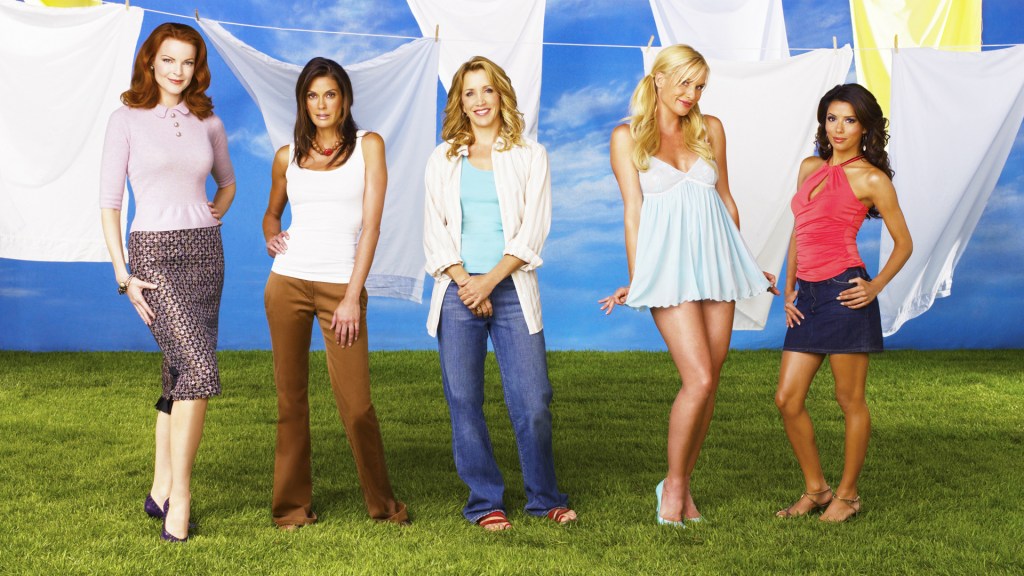
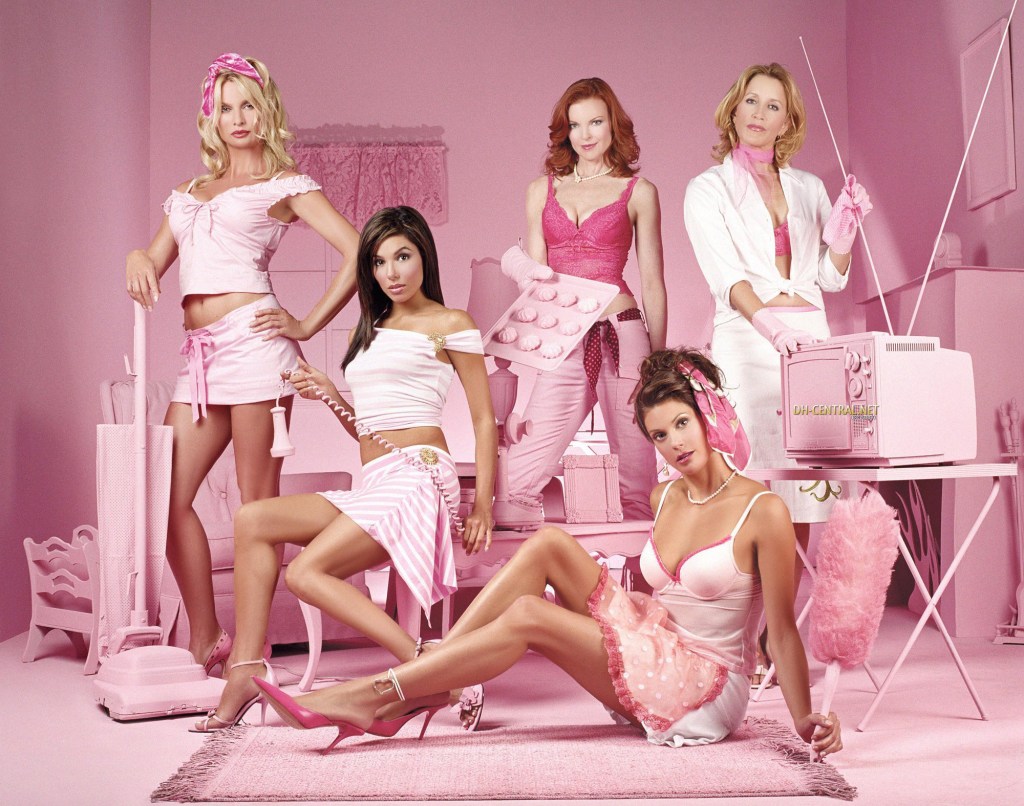

One of the main arguments against the series is that even though it started in 2004, the show still takes old-fashioned approach to womanhood by recreating tired domestic stereotypes. Even before the very first episode’s broadcasting, the women of the show were already defined in terms of their marital and domestic roles, whether in the images promoting the show or in the title.
“Desperate Housewives really should have an even more obvious title, like Cynical Suburban Sluts”
The president of the Parents Television Council (2004)
As it is made in the 21th century (and occurs in it as well), viewers would anticipate a modern representations of women; yet the show renders old stereotypes.
There are four main characters that stay throughout the entire show:
Susan Mayer, the weak one
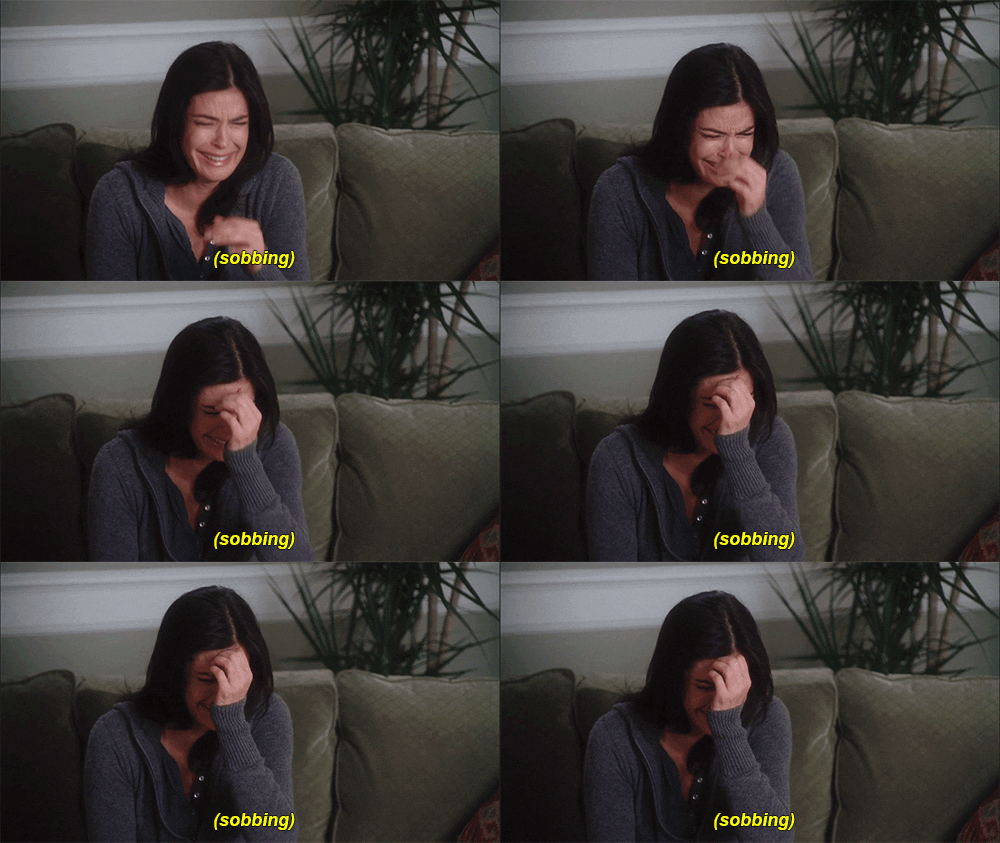
In the first season, she is a divorced single parent, after her husband cheated on her. She is represented as the romantic and sensitive woman, often appearing crying over her relationship problems with men. She might seem independent, but actually depends a lot on her daughter Julie, who’s only 13 at the beginning of the show, even if she does seem much more mature than her mother. Susan is presented as very unconfident and sensitive, as well as dependent on men for her own happiness. In the first season, however, she is the only of the four women who is not presented as a housewife. She works as a children book illustrator (although she works at home and seems to have a lot of free time).
« I go after men because I want men. You go after them because you need them. You’ve got holes in your heart that can only be filled by a pair of trousers. Face it, Mayer, you’re weak »
Eddie, (Season 5, episode 12)
Lynette Scavo, the mother

Lynette is a stay-at-home mom who pretty much spends her life taking care of her 4 children (5 in the last seasons), cleaning (if she manages to find time for it) and cooking (food that her husband and children probably won’t even appreciate). Yet, it was not always like that: she used to be a successful businesswoman, known as “the shark”. She sacrificed her dream in order to stay at home with her family, after her husband asked her to do so. Her children are very troublesome and she struggles every day to cope with the situation, while her husband is often away on business trip or at work. Lynette basically always follows Tom’s wishes (quit her job, go back to work, open a restaurant, etc.). She is shown to be very tired of the situation and does not seem very happy about it. Lynette almost always appears on the screen dressed in baggy clothes, wearing no make-up, and constantly looking tired because, as she says herself, she doesn’t even have time to wash her face.
Gabrielle Solis, the sexual object
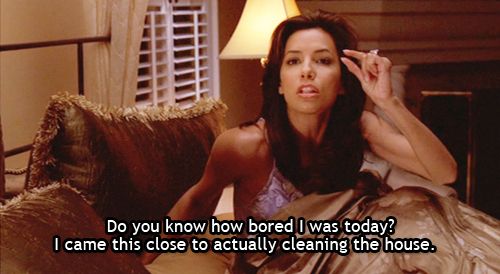
Unlike Lynette who doesn’t have one second for herself, Gabrielle pays a lot of attention to the way she looks; her hair and make-up are always done perfectly. She used to be a famous model in New York but doesn’t work anymore. She is unhappy in her marriage with Carlos, whose priority is to work. She is shown to be extremely lonely and to keep herself entertained, she has an affair with her teenage gardener. She married Carlos for his money, even though she doesn’t love him. Carlos thinks he can make her happy by buying her everything she wants, no matter how expensive it is. Gabrielle is labelled as a sexual object, often using her sexuality to gain male attention.
Gabrielle – No, no, no. I’m not going.
Carlos – It’s business. Tanaka expects everyone to bring their wives.
Gabrielle – Every time I’m around that man, he tries to grab my ass.
Carlos – I made over $200,000 doing business with him last year. If he wants to grab your ass, you let him
Season 1, Episode 1
Bree Van de Kamp, the perfect housewife

Bree is by far the most ‘traditional’ female character of the four. She spends her day cooking and cleaning the house, as well as taking care of two teenage children. Her home-cooked meals are divine, her house is spotless, but her family is very unhappy. Yet, she always has a smile on her face, being very good at keeping up appearances. Her emotional coldness and her obsessive need to seem perfect leads her children and husband to resent her.
As for male characters, many of them behave in total opposition with feminist ideals: Carlos messes up with his wife’s birth control because she doesn’t want to have children whereas he does, Tom Scavo asks Lynette to abandon her career to take care of their children, and then forces her to go back when he wants her to, not to mention Orson who asks Bree to sell her company in order to be the devoted wife she is not anymore.
The characters’ evolution
Many people criticize the old-fashioned stereotypes represented by each of the four main female characters as well as the sexist behaviour of the male characters, but others underline the satirical nature of the show, saying it uses feminine stereotypes in order to highlight their ridiculous nature. We can certainly not say that the women of Desperate Housewives are fighting for complete equality with men, but according to Virginie Macuraci, the show’s feminism lies in the fact their condition is never accepted. One can say that the show did a great job in giving the characters complexity making them grow throughout the show, going thereby beyond the stereotypes. For many viewers, feminism in the show lies in the evolution given to the four main women. For instance, Bree starts her own company, Lynette goes back to work (although it’s not her own wish at first), and Gabrielle starts working as a personal shopper. As for Susan, she asserts herself throughout the seasons. Another example would be Bree, who goes from being the perfect housewife to a fierce company director. Her husband Orson feels he is being abandoned and asks her to abandon her company, to which she answers: “Orson, think about how I built this company from nothing. How it brings me joy and pride and a sense of accomplishment. Is it that really something you want me to give up?” (Season 5, Episode 18). Fortunately, instead of fulfilling his desire when he answers yes to that question, she follows hers, asking for the divorce.
In term of evolution of characters, we can also mention the very last scene of the show in which we’re told Lynette moves to New York, where she becomes a CEO, Gabrielle develops her personal shopping website which leads her to get her own show, Bree enters local politics and is elected to the Kentucky State Legislature. As for Susan, we don’t know what she becomes, except that she leaves Wisteria Lane as well. Although this scene shows a clear evolution if we compare the characters in the first and last seasons, we should also underline that it still has an annoying way of presenting things: it’s Lynette and Tom who buy the apartment overlooking Central Park, but only Lynette who takes her grandchildren to the park and yell at them (where are you Tom?), we’re not told Gaby developed her own shopping website but that it is Carlos who helped her to do it, in the same way it’s Trip who encourages Bree to enters politics (as if they could not have done it without them).
The Feminine Mystique (1963)
A comparison is often made between Desperate Housewives and Betty Friedan’s “Feminine Mystique” (1963), which is regarded as one of the most important American feminist text. In a PhD thesis written by Virginie Marcucci on Desperate Housewives, we’re given several examples of how the two of them share similarities.
Betty Friedan started to write her book when she realized how unhappy housewives living in seemingly-perfect suburbs could be. The starting point of Desperate Housewives is the same: we’re presented with a reality which is at first glance idyllic in an American well-off suburbs with beautiful women living in perfect happiness. Yet, as in Desperate Housewives – which starts with the suicide of one of the perfectly beautiful happy housewives living in the perfectly beautiful suburbs – the book soon underlines the silent disease that torments these women (the problem that has no name, as she calls it). Therefore, for Virginie Marcucci, the approach is the same: while Betty Friedan gave women the words to talk about their “problem”, Marc Cherry gave them the images, many of them recognising themselves in the diagnosis of the series.
According to Friedan, the housewives’ problem manifests itself in many ways such as exhaustion, and they often take refuge in drinking and drugs. This idea is echoed in the series with Bree developing dependence for alcohol and Lynette becoming addicted to her children’s medicines, which allow her to be less tired.
« Why can’t you drink alone in your room like Tammy’s mom? »
Danielle Van de Kamp to Bree(Season 2, episode 15)
Then, Friedan reports in her book some statements of housewives crying of relief when they discover they are no exception: the other housewives know the very same problems. This is reminiscent of a powerful scene of Desperate Housewives in which Lynette falls apart in tears, thinking she is a horrible mother, but then eventually feels better when she realises she’s not the only one who feels this way. Lots of women reacted to these kind of scenes saying it helped them feeling better about themselves.
Friedan also talks about women for whom sexuality becomes a way to exist. This clearly reminds us of Gabrielle Solis, who uses her affair with John as an antidote against her lonely life. As Mary Alice says when presenting us Gaby: “Gabrielle only saw her gardener as a way to infuse her life with a little excitement” (Season 1, Episode 1).
The last example I chose to illustrate the similarities between Friedan’s feminist book and Desperate Housewives is the fact that, according to the American author, the efforts a woman does at her home to be perfect for her husband and children are only responded to with poor gratitude. This echoes Bree’s family, who even despises her for all she does for them, as we can see in the following scene. Bree’s children clearly don’t appreciate all her efforts and her husband does not give her any sign of support.
We don’t know if Marc Cherry has read Friedan’s book or not, but we cannot deny the aspects the show share with what is regarded as one of the most important American feminist book. This, for lots of critics, situates the show at the core of problematics that are indisputably feminists. However – once again –, others say the show actually goes back to a pre-Betty Friedan America and that those common points with The Feminine Mystique are actually the first sign of post-feminism questioning.
Desperate Housewives and post-feminism
A word that comes out a lot when studying Desperate Housewives is “post-feminism”. According to Richardson, « Far from building upon the achievement of second-wave feminism, post-feminism returns women to the situation they were in before the work of Betty Friedan » (Richardson cited by Virginie Marcuci). Many people have criticized Desperate Housewives from a feminist perspective, arguing that the show is nothing more than a postfeminist backlash to answer the current crisis of masculinity. For some people, post-feminism puts aside all the achievements accomplished by the second wave of feminism and therefore takes women back to a prefeminist world. In today’s world, women have more freedom than before – thank god! –, but Desperate Housewives seems to question this postfeminist world, showing a society in which it is complicated for women to have choice and assume the consequences of them. Ashley Sayeau, in Reading Desperate Housewives Beyond the White Picket Fence, criticized this, saying that in the mind of Marc Cherry, the creator of the series, it seems that the women of Wisteria Lane actually suffer from too much freedom.
« We’ve reached the point where we realize that no, you really can’t have it all… Long ago, it used to be easier: society laid down the rules for you. Now, there are a lot of choices, but sometimes choices can lead to chaos »
(Marc Cherry cited by Ashley Sayeau)
Desperate Housewives would therefore put forward the unhappy woman who struggles to find satisfaction in the pressure of succeeding in multiple aspects of life as a result of the feminist movement. Moreover, it might be said that the show rarely offers feminist solutions which in a sense leaves the housewives more desperate than ever. According to Sayeau, the series seems sincere at first in its representation of the trials and tribulations of stay-at-home moms. But in the end, the show’s ambitions fall flat and the women are left more helpless than ever, which is why she categorizes the show as being faux feminism. Wisteria Lane is no secret feminist retreat: Desperate Housewives borrows the feminist language, but denigrates its essence.
« Desperate Housewives represents the best of what we might call faux feminism – that subtle, yet increasingly pervasive brand of conservative thought that casts itself as deeply concerned with the frustrations of modern women, but can ultimately offer no alternatives except those of a traditional stripe »
(Ashley Sayeau)
Many people criticized the fact the characters ridiculed for their failure to live up to post-feminist ideals. Most of the women of the show strive meet the idealistic standards of feminity and motherhood, but are made fun of for their failure in the domestic sphere, among others. This is the case of Lynette, for instance, who’s tired of feeling like a failure and thinks she’s the most horrible mother on earth. She’s always presented as losing control, not being able to deal with the pressure. And she is not helped by her husband Tom, who when returning from work takes control of the children questioning why she finds it so difficult: “They’re just kids for god sake”
An oppositional reading of the relationship between Tom and Lynette suggests that Lynette’s plea for help within the domestic sphere could be used to satirize hegemonic definitions of motherhood, showing how unequal division of labour in a couple can lead to dysfunction (Sharpe cited by McCabe and Akkas 2006).
So, as I warned you, this is an impossible consensus. I would go with Sayeau when she says Desperate Housewives borrowed the feminist language but lost itself in the process. This does not change the fact that it clearly has its place in my top 10 favourite series, and the fact we can discuss this kind of topic without finding a clear answer probably makes me like it even more.
What about you? What do you think the show has to say about contemporary womandhood? Is it feminist or anti-feminist? Or both? Do you think it is enough to say the show is satirical to say it is feminist?
Bibliography
Hill, Lisa, “Gender and genre: situating Desperate Housewives”, Journal of Popular Film and Television. Vol. 38, no. 4, (2010): 162-169.
Marcucci, Virginie. « Desperate Housewives, miroir tendu au(x) féminisme(s) américain(s)? ». Diss. U. of François-Rabelais de Tours, 2010.
Sayeau, Ashley. « Having it all: Desperate Housewives’ flimsy feminism » Reading Desperate Housewives Beyond the White Picket Fence. Ed. Janet McCabe and Kim Akass. New York: I.B. Tauris, 2006: 42-47.
Sayeau, Ashley. « » Reading Desperate Housewives Beyond the White Picket Fence. Ed. Janet McCabe and Kim Akass. New York: I.B. Tauris, 2006: 42-47.
 The One with the Blog
Laisser un commentaire