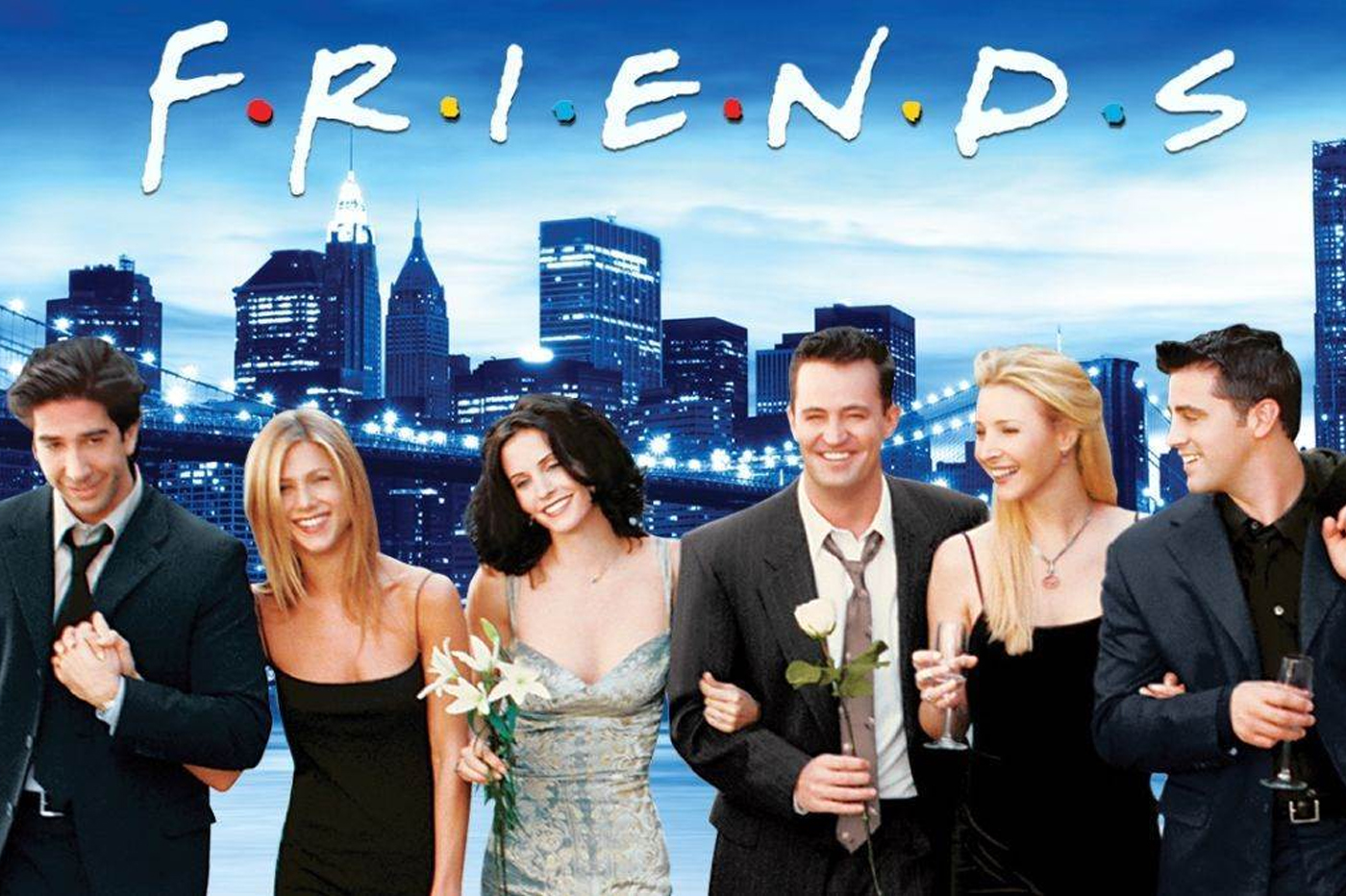
How many people have not dreamt of having a cup of coffee in Central Perk? Who has never heard about those six flatmates living in New York? How many people have not sang on the soundtrack I’ll Be There for You? Created in 1994 by David Crane and Marta Kauffman, the famous sitcom Friends has followed during ten years the life of six friends in their 20s: Rachel Green, Phoebe Buffay, Joey Tribbiani, Chandler Bing, Monica Geller, and her brother Ross Geller. Throughout ten seasons and 236 episodes, the group of friends goes through many fights, romances, family problems, money troubles, laughs and tears, which enabled them to learn what friendship really means.
Despite being widely regarded as one of the most popular TV shows of all time, lately the sitcom has not gone down very well with a new generation of viewers. Indeed, as the 90s show is watched through 21st-century eyes, it is said that it has not aged particularly well. Nearly a quarter of century has passed since Friends was first broadcasted, and while a new generation of viewers are discovering the hit show now available on Netflix, the sitcom is not left uncriticized. Indeed, millennials are taking a critical look at the show, and it seems that what was a must-see show for an entire generation in the 90s is now regarded as problematic for another. As reported by The Independent, the show was widely criticized on social networks by new viewers, but also by people who had known the sitcom in the 90s and wanted to benefit from its arrival on Netflix to rediscover their favourite show. Many were left disappointed by the storylines of Friends, and agreed with the millennials who accused the show of racism, sexism and homophobia. Of course, everybody does not agree on saying Friends is problematic. Many people fight tooth and nail against the accusations against their favourite show, lacking sometimes of objectivity. This article is the first of a series of three which are going to deal respectively with racism, sexism and homophobia in the sitcom. We will also see how political correctness had had a massive impact on people’s tastes and how it can explain the recent reactions to the iconic sitcom Friends.

Friends is categorized as a sitcom, which means a situation comedy. As its name suggests, the sitcom gives a lot of importance to the comic, using humor in different ways. Brett Mills, in “The Sitcom”, explains that, although it might be obvious to say, “the sitcom’s primary aim is to be funny; it is defined by its humorous content and audiences come to it with the expectation of laughter. A sitcom with no jokes is not a sitcom” (2009: 5). In his book, Mills argues that the sitcom can be said to have a ‘comic impetus’: its humour is always of paramount concern, even though the sitcom can do other things and can be enjoyed for other reasons (2009:5-6). The humour is therefore the most obvious characteristics of the genre, but other aspects of it are also its length, that is less than half an hour per episode, its domestic setting, its fixed set of leading characters, usually part of the same family or group of friends, and its shooting style, which developed in response to the genre’s theatrical rots: it was an attempt to capture such a performance in a manner suitable for television (Mills 2009: 39). The laugh track is also an important characteristics of the sitcom, although not essential. It suggests there is “a collectively agreed notion of when it is appropriate and inappropriate to laugh” (Mills 2009: 103). The sitcom being a genre which core characteristic is the use of humour, there is nothing surprising in the fact that it can raise debate about inappropriate comic content, especially now that political correctness has taken such an important place in our society.
Lack of diversity
One of the main criticism on Friends is that there is a complete lack of diversity in the show. Even if most of humor is centred on the differences between the down-to-earth Ross, the naïve Joey, the psychorigid Monica, the fashionista Rachel, the sarcastic Chandler and the unconventional Phoebe, there is a limit to their differences (Banerjee 2006: 412). Indeed, the six leading characters are all white, straight and middle-class. With the exception of Ross’ girlfriends Julie (Season 1 and 2) and Charlie Wheeler (Season 9 and 10), there is no non-white characters appearing in several episodes in a row. The Hollywood movie industry, and by extension the American series were often criticized for their lack of ethnic diversity since most of them portray only white characters. As Jason Mittell argues in Television and American Culture, “throughout television history, the majority of programs have presented characters and performers unmarked in their racial and ethnic identity. In America, this ‘default’ identity is white” (2010: 315). Therefore, Friends, by its lack of ethnic diversity, can be said to be a relevant example of how popular culture in the United States “has assisted in the maintenance of a white supremacist racial hierarchy” (Dirks and Mueller: 116), and how black characters have been marginalized in order to glorify and maintain the white-dominated order (Dirks and Mueller: 116). Considering how multicultural New York is, it is impossible not noticing that there are only two non-white characters appearing in several episodes in the entire show. Even when we look closer and pay attention to the extras, one can notice that they are almost all white. How plausible it is to walk in a coffee shop several times every day in Greenwich Village in Manhattan and be surrounded by almost only white people? In 2000, the New York City Department of City Planning reported that 45,8 per cent of the population living in Manhattan were white, which means that more of the half represented other races: 27,2 per cent were from Hispanic origin, 15,3 per cent were black, 9,3% were Asian, and 2 per cent were American Indian or Alaska Native (Marshall 2007: 134). Even if the majority of people living in Manhattan at the time were white, there were also many other ethnicities, and these were not represented by the sitcom Friends, which led the show to be highly criticized. As Marshall argues in her PhD thesis on Friends, it “should have had an edge over the other series to discuss racial differences in a positive light because of its mass popularity with viewers” (2007: 135). Instead, when a guest character from another origin was introduced in the series – and there were only two, as we have seen – the other characters made fun of them or found reasons not to like them. Indeed, as Marshall suggests with the title of her PhD thesis “I’ll be there for you” If you are just like me, it was only acceptable for the group to be friends with people who looked just like them, and they always found a way to reject non-white characters.

The first named non-white character is Julie, Ross’ Asian girlfriend, introduced at the end of the first season in The One Where Rachel Finds Out, when Ross comes back from his trip to China. When they both arrive at the airport, we learn about Julie being nervous that Ross’ friends might judge and ridicule her, which suggests that she is aware her different origin might influence her acceptation in the group. The first episode of the next season starts with Rachel, who is waiting for Ross at the airport, but she soon discovers he came back with a girlfriend. Surprised, she addresses Julie for the first time saying in a very loud and over articulated way: “Welcome to our country!”, to which Julie answers “Thank you, I’m from New York”, in an even louder manner. Ross’ relationship with Julie is not going to last, as in the eighth episode of the same season, he chooses Rachel over Julie, choosing whiteness over ethnological difference, as Marshall suggests (2007: 113). Julie was never accepted in the group of friends. Rachel, in spite of all the efforts Julie does to be nice to everyone, despises her because she is in love with Ross and cannot be with him as long as he is with Julie. As a result, Julie was outcast of the group. Chidester argues that Julie was badly treated in comparison to Ross’ other girlfriends throughout the show, which “speaks to a threat well beyond her presence as a simple substitute for Rachel’s affections” (cited by Marshall 2007: 114).

A similar analysis can be made with the only other named non-white character of the show, Charlie Wheeler. She is a black woman introduced at the end of the ninth season. She is first Joey’s girlfriend and then switches to Ross. Even if she seems to be more accepted in the circle of friends than Julie, she does not appear for long, as we only get to know her for nine episodes. Moreover, it is important to notice that she appears in the penultimate and last seasons, which means that the show had already been broadcasted for nine years and none black recurrent character had been introduced in the show at that time. In that case, Rachel also despises her, but that time because she has feelings for Joey.
Rachel’s disapproval for both Julie and Charlie, although it grows out of romantic feelings for Ross and Joey, shows that non-white characters did not have a place in the group, as it is argued by Marshall (2007: 116). However, it is important to underline the fact that few characters actually get to be accepted in the group of friends. Marshall suggests that Julie and Charlie were outcast because of their ethnicity, but it seems that the six flatmates actually do not let anybody enter their closed circle of friends, even when they are white. For instance, Chandler’s recurrent girlfriend Janice is despised by most of the group, Rachel got Ross’ girlfriend Bonnie to shave her head so that Ross would break up with her, Emily, Ross’ English wife is often laughed at for her British accent and despised by the entire group for preventing Ross to see Rachel, none of Phoebe’s numerous boyfriends got to hang out with them, and Joey’s roommate/girlfriend moved out after fighting with Monica and Chandler. Except Monica’s boyfriend Richard in season two who gets to be accepted as “one of the guys” during some episodes (although it is only because Joey and Chandler are impressed by his Jaguar), nobody really enters the closed circle of friends, which means that Julie and Charlie were maybe not excluded from the group because they were not white, but only because nobody can really enter it. Of course, whether it is because of their origins that Julie and Charlie were not accepted in the group or for other reasons, it does not change the fact that they are the only characters representing other ethnicities in the show and both of them are portrayed only during a few episodes, which shows how the sitcom failed to represent the multiculturality of New York.
Consolidation of Whiteness
In a very interesting article dealing with ethnic treatment in Friends, Mita Banerjee analyzes a character who does not actually appear in the show. Indeed, in the episode The One with the Sharks (Season 9), Phoebe has a new boyfriend, named Mike. Ross, in one of his too-much-talking-moment, compromises Phoebe’s relationship by telling Mike she never had had a long-term relationship. Realizing his mistake, he tries to cover it up by making up a story out of nowhere: Phoebe had had a six-year relationship with a man named Vikram, who was Indian. At the end of the episode, Ross impersonates the character he created over the phone. Of course, Vikram talks with the accent we expected him to have, which, according to Banerjee, makes the viewers laugh at him because they knew he would sound like this. It can be said that Ross is consolidating his own whiteness through an act that Banerjee compares to the theatrical tradition of blackface minstrelsy, highly regarded as a racist tradition (2006: 420). Moreover, the author argues that this episode is representative of the fact that the Indian might have become an important part of the American labor market, but still has not achieved cultural presence. What Friends does with this episode is to reinforce the idea that there is a need for cultural exclusion to compensate with the transnational inclusion in the economic sphere: “the cultural restores what the economic has failed to retain: cultural homogeneity” (2006: 416). According to Banerjee, the reason of Vikram’s absence is not only because Ross has invented him and therefore cannot physically appear, but this absence would suggest a deeper sense of cultural anxiety. The episode represents the consolidation of whiteness by excluding someone who is economically, but not culturally part of the nation: « The gesture towards a physical presence which remains absent from the show itself may thus be significant of a shift in the representation of South Asians in mainstream media: they cannot not be represented, but their representation is ambivalent; they are not yet seen as part of the national imaginary » (Banerjee 2006: 416). In spite of this analysis, the author concludes we cannot talk about racism in that case because the assumptions cannot be matched with a real presence: Vikram never actually appears, which save the show from the charge of racism, according to Banerjee (2006: 419).
Racist connotations
This is actually a reflection that can be applied to the entire show: does the lack of racial diversity directly implies that Friends is racist or does the fact that it portrays (almost) none character from a different origin saves it from any racist representation? It is maybe even worse not to include non-white characters in a sitcom which takes place in New York, one of the most multicultural cities of the world. It seems that it was better for the producers not to be realistic by distancing the show from New York’s multiculturality than casting non-white people. Moreover, despite the fact there is almost none non-white character in the entire show, it can be said that there is some racist content conveyed through some of the leading characters’ actions. For instance, most viewers agree on saying the episode with Monica’s hair left them uncomfortable due to its racist connotations. Indeed, in The One in Barbados, parts one and two (Season 9), the group of friends goes on a trip to Barbados, where the hot and humid weather makes Monica’s hair all frizzy. When her friends see her, her hair is immediately the butt of jokes. Her husband Chandler even explains that it is “why [their] honeymoon photos look like [him] and Diana Ross”. Later, Phoebe carries on with the joke asking Monica if she is planning on leaving The Supremes, that is Diana Ross’ ex-group of music. The jokes on Monica’s hair go on during two entire episodes: Chandler says it is the first time he feels he is the most attractive one of the two, and only agrees to sleep with her because she says she is going to put a pillowcase over her head. He even calls her “Buckwheat”, which is the name of a black character in Our Gang (aka Little Rascals), short American films from the 30s and 40s which were controversial for the “pickaninny” stereotypical characters, “buckwheat” being a pejorative term referring to black people. Tired of all these jokes about her hair, Monica goes to the salon to make it better, and comes back with cornrows, which is also made fun of by her friends. For example, Chandler says he does not want to sit next to Allen Iverson (an American professional basketball player), referring to his wife. Many viewers criticized the racist content of the scene, due to the fact that Monica’s hairstyle is likened to Diana Ross and is made into a ridiculous joke. Monica’s herself mocks it as well by behaving like a fool while she has her cornrows: she gets hurt with the shells she put in her hair, she gets her braids stuck in the shower while she is dancing and singing Bob Marley’s song and she wears a rasta hat, playing upon stereotypes. For all these reasons, this scene can be said to be a good example of how the sitcom, even without portraying non-white characters, contains some racist connotations.
If you’re interested to know more about political correctness in the sitcom Friends, check out my two other articles « The One with the Sexist » and « The One with the Homophobe » (soon online).
Please share your point of view on the topic and let me know what you think!
Bibliography
- Anonymous (RT). “Friends VS Political Correctness: What happens to having a sense of humour in the Age of PC?” ELB News. n.p. January 2018. Web. Accessed 16 April 2018. https://eblnews.com/video/friends-vs-political-correctness-what-happens-having-sense-humor-age-pc-305131
- Barber, Nicholas. “Comedy in the Age of Outrage: When Jokes go too far” BBC. n.p. August 2015. Web. Accessed 23 March 2018. http://www.bbc.com/culture/story/20150804-comedy-in-the-age-of-outrage-when-jokes-go-too-far
- Barnejee, Mita. “Vikrams of Change: The Suspended Transnational Presence of the Indian on “Friends” Amerikastudien/American Studies Vol. 51, No. 3 (2006): 411-423.
- Crane, David and Marta Kauffman. Friends. NBC, 1994-2004.
- Dirks, Danielle and Jennifer C. Mueller. “Racism and Popular Culture.” Handbooks of Sociology and social Research. Ed. John Delamater and Amanda Ward. St. Louis: University of Missouri-St. Louis, 2007: 155-129.
- Kali Holloway, Alternet. “Toxic Masculinity is Killing Men: The Roots of Male Trauma” Salon. n.p. December 2015. Web. Accessed 23 March 2018. https://www.salon.com/2015/06/12/toxic_masculinity_is_killing_men_the_roots_of_male_trauma_partner/
- Kaplan, Ilana. “Millennials watching ‘Friends’ on Netflix shocked by storylines” Independent. n.p. January 2018. Web. Accessed 31 March 2018. https://www.independent.co.uk/arts-entertainment/tv/friends-netflix-sexist-racist-transphobic-problematic-millenials-watch-a8154626.html
- Kelly, Emma. “Carol and Susan Weren’t Allowed to Kiss When They Got Married on Friends” Metro. n.p. September 2017. Web. Accessed 23 March 2018. http://metro.co.uk/2017/09/15/carol-and-susan-werent-allowed-kiss-when-they-got-married-on-friends-6931148/
- Kimmel, Michael. “Masculinity as Homophobia: Fear, Shame, and Silance in the Construction of Gender Identity.” Theorizing Masculinities. Ed. Harry Brod and Michael Kaufman. Thousand Oaks: Sage Publications, 1994: 58-70.
- Masciotra, David. “Toxic Masculinity Doesn’t Just Target Women: The Viciousness and vacuity of modern American manhood is also harmful to the self” Salon. n.p. May 2016. Web. Accessed 23 March 2018. https://www.salon.com/2016/07/04/toxic_masculinity_doesnt_just_target_women_the_viciousness_and_vacuity_of_modern_american_manhood_is_also_harmful_to_the_self/
- Marshall, Lisa Marie. “I’ll Be There For You” If You Are Just Like Me: An Analysis of Hegemonic Social Structures in “Friends”. Diss. U of Bowling Green State, 2007.
- Mills, Brett. The Sitcom. Edinburgh: Edinburgh University Press, 2009.
- Mittel, Jason. Television and American Culture. New York: Oxford University Press, 2010.
- Weiss, Suzannah. “6 Harmful Effects of Toxic Masculinity” Bustle. n.p. February 2016. Web. Accessed 23 March 2018. https://www.bustle.com/articles/143644-6-harmful-effects-of-toxic-masculinity
 The One with the Blog
Laisser un commentaire